Oxford Comma Examples: Why It Matters in Professional Writing
If you’ve spent any time on the internet, you’ve likely seen this classic illustration:
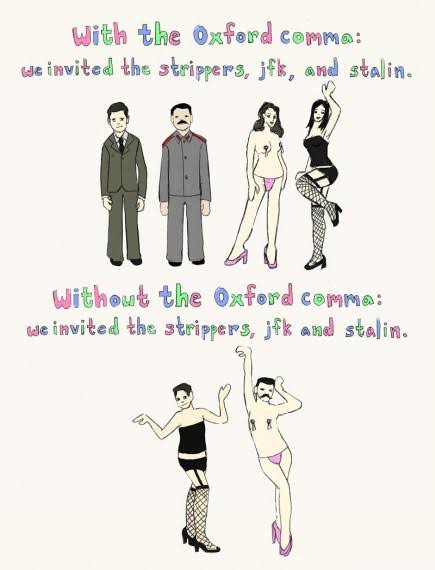
Without the final comma, “the strippers, JFK and Stalin” accidentally turns JFK and Stalin into the strippers. With the comma, it’s clear that four separate guests are attending the party.
While that example is funny, ambiguity in real-world business writing isn’t. Omission of a single comma in a legal contract, scope of work, or medical report can lead to costly misunderstandings, scope creep, or legal disputes.
Here is a clear breakdown of how the Oxford comma works, when to use it, and real-world examples showing why it matters in professional documents.
What exactly is the Oxford comma?
The Oxford comma (also known as the serial comma) is the final comma placed before the conjunction (like and or or) in a list of three or more items.
A comma serves two main functions in a sentence:
- Separating distinct clauses or chunks of information.
- Separating items in a list.
The Oxford comma’s job is to prevent those two functions from getting confused. Without it, your reader might read two separate list items as a single combined description.
7 Real-World Oxford Comma Examples in Business Writing
Let’s look at how omitting the serial comma creates genuine risk in professional contexts.
1. Scope of Work & Deliverables
Without: As part of this engagement, we will conduct a full audit of your content workflow, interview key stakeholders across marketing and product, deliver a written report with recommendations, style guide and templates, and provide one round of revisions.
With: As part of this engagement, we will conduct a full audit of your content workflow, interview key stakeholders across marketing and product, deliver a written report with recommendations, style guide, and templates, and provide one round of revisions.
The Risk: Without the comma, “style guide and templates” can be interpreted as sub-components of the report, rather than standalone deliverables. In a client agreement, that ambiguity easily triggers scope creep or billing disputes.
2. Legal Contracts & Reimbursements
Without: The Consultant shall be entitled to reimbursement for reasonable expenses incurred, including travel, accommodation, client entertainment and software licensing fees.
With: The Consultant shall be entitled to reimbursement for reasonable expenses incurred, including travel, accommodation, client entertainment, and software licensing fees.
The Risk: Without the comma, “client entertainment and software licensing fees” reads as a single combined category. If client entertainment expenses are capped by policy but software licenses are not, this vagueness opens the door to contested expense claims.
3. Financial & Investment Disclosures
Without: The fund’s returns are affected by market volatility, currency fluctuations, changes in interest rates, the performance of underlying assets and management fees.
With: The fund’s returns are affected by market volatility, currency fluctuations, changes in interest rates, the performance of underlying assets, and management fees.
The Risk: Without the comma, it reads as though fund returns are affected by the performance of the management fees, implying fees fluctuate based on asset performance rather than being a set cost. In financial reporting, this opens the door to misrepresentation claims or investor disputes over fee structures.
4. Manufacturing & Operational Safety Checklists
Without: Confirm that the safety guards are reattached, the pressure valve has been reset, lubrication levels are checked and the emergency stop is tested.
With: Confirm that the safety guards are reattached, the pressure valve has been reset, lubrication levels are checked, and the emergency stop is tested.
The Risk: A technician skimming a checklist under time pressure might read “lubrication levels are checked and the emergency stop is tested” as a single combined step; possibly marking off both after only performing one. On a plant floor, this ambiguity creates a direct physical safety gap and a compliance violation.
5. Healthcare & Patient Discharge Instructions
Without: Please ensure the patient continues prescribed antibiotics, monitors the wound site for signs of infection, avoids strenuous activity and heavy lifting and returns for a follow-up appointment within seven days.
With: Please ensure the patient continues prescribed antibiotics, monitors the wound site for signs of infection, avoids strenuous activity and heavy lifting, and returns for a follow-up appointment within seven days.
The Risk: The instructions run together, making it unclear whether returning for a follow-up is mandatory or conditional on avoiding heavy lifting. For an exhausted caregiver, that confusion risks a missed post-op checkup and delayed treatment for complications.
6. Property Listing Agreements
Without: The seller agrees to disclose any structural defects, past water damage, disputes with neighbouring properties and unpermitted renovations.
With: The seller agrees to disclose any structural defects, past water damage, disputes with neighbouring properties, and unpermitted renovations.
The Risk: “Disputes with neighbouring properties and unpermitted renovations” can be read narrowly as disputes involving unpermitted renovations, rather than two independent disclosure requirements. A buyer’s lawyer can easily exploit that loophole to hold the seller liable for undisclosed property disputes after closing.
7. School & Childcare Emergency Forms
Without: Please list any allergies, medications and conditions we should know about.
With: Please list any allergies, medications, and conditions we should know about.
The Risk: “Medications and conditions” can look like a single paired field, leading parents to leave out critical medical context. In an emergency, an incomplete medical profile leaves staff without critical, life-saving information.
When Should You Use the Oxford Comma?
If you are writing to a style guide, defer to that first. For instance, AP Style generally omits the serial comma unless needed for clarity, whereas the Chicago Manual of Style mandates it.
If you are setting your own editorial standard, default to using the Oxford comma consistently. While simple lists do not strictly need the clarifying comma, mixing styles within the same document makes your brand look careless. Establishing a consistent rule eliminates guesswork for your writers and keeps your documents clear.
But remember, just as not every job needs a hammer, the Oxford comma may not be the best tool for the job at hand. There are many ways to make sure your message lands clearly with your reader. You can read more about these tools here.
Have a writing or communications project you’d like to talk through?
Book a free 45-minute call to chat about what you’re working on and how I can help.
Keep Your Communications Clear and Consistent
The Oxford comma is just one example of how subtle editorial choices impact professional clarity. The details you don’t think about are often the ones that cause costly misunderstandings down the line.
- Looking to establish consistent writing standards across your team? Explore Style Guide Development services to create clear rules for your brand.
- Have a critical proposal, contract, or manuscript that needs a second set of eyes? Check out my Content Editing or Technical Editing Services.